

A confidence-based, artificial intelligence pathology model for diagnosis of intrahepatic cholangiocarcinoma
Cheng et al., Annals of Oncology, 2026
Diagnosing Intrahepatic Cholangiocarcinoma (ICCA) is a major clinical hurdle. Because its histological features closely overlap with those of metastatic liver cancers, patients often endure a battery of expensive and invasive tests—such as endoscopies—to rule out other primary tumor sites. These "exclusionary investigations" lead to critical treatment delays and increased healthcare costs. Here we performed a multi-center study that involved the development of AI2CCA (Artificial Intelligence for ICCA diagnosis), a deep-learning model designed to solve this exact problem using routine liver biopsy slides. We also prospectively validate it on 4 centers across the globe.

Artificial intelligence-based pathology as a biomarker of sensitivity to atezolizumab-bevacizumab in patients with hepatocellular carcinoma: a multicentre retrospective study
Zeng et al., Lancet Oncology, 2023

We show in this paper that Artificial Intelligence-based pathology is able to predict clinical outcomes in patients with advanced hepatocellular carcinoma treated by atezolizumab/bevacizumab.
The model was developed in more than 300 patients and further validated in 3 cohorts: resected patients, biopsied patients and a real-world cohort of patients treated by atezolizumab/bevacizumab.
Artificial intelligence in liver cancer - new tools for research and patient management
Calderaro et al., Nat Rev Gastroenterol Hepatol, 2024

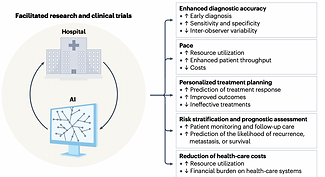

This review discusses the main applications of AI for liver cancer.
Deep learning-based phenotyping reclassifies combined hepatocellular-cholangiocarcinoma
Calderaro et al., Nature Communications, 2023
This manuscript shows that Artificial Intellligence can reclassify combined HCC-CCA as conventional HCC or cholangiocarcinoma, and that this reclassification has clinical and molecular relevance

